
Friendsgiving games are a wonderful addition to an autumn gathering with friends. These 13 games for adults include conversation starters, icebreakers, printable table games, friendly competitions, and even a murder mystery for an entire evening.
I think one of the nicest things about Friendsgiving is that you can make it whatever suits your group. Some friends are perfectly happy talking around the table for hours. Others will turn the most innocent guessing game into a competition. And sometimes, the people you least expect are the ones who get the most carried away.
I like games that give people something to laugh about or a new story to tell. My adult game choices are also clean and good-natured. They can be silly and competitive without making anyone blush.
So, whether you’re gathering with longtime friends or bringing a new group together, here are some Friendsgiving games to consider.
Disclosure: Some links in this post are affiliate links, which means I may earn commission at no extra cost to you. See our full disclosure and liability disclaimer.
1. Never Have I Ever
Good fit for: Icebreakers · New friends · Surprising stories
Never Have I Ever can reveal some surprising things about your friends. Even people who have known each other for years may discover stories they’ve never heard before.
What You Need
- Ten pieces of candy per player, or simply use your fingers
How to Play
- Each player begins with ten pieces of candy or holds up ten fingers.
- Take turns making statements beginning with “Never have I ever…”
- Anyone who has done the thing mentioned eats one piece of candy or lowers one finger.
- Continue until only one player has candy or fingers remaining.
For a Friendsgiving version, you could use statements such as:
- Never have I ever forgotten to bring something to a potluck.
- Never have I ever eaten dessert before dinner.
- Never have I ever fallen asleep at someone else’s house (sleepovers don’t count).
- Never have I ever gone on a trip without knowing where we were going.
- Never have I ever laughed so hard I couldn’t finish telling a story.
I love this game because there are some interesting stories behind those lowered fingers.
You can also skip the elimination entirely and keep playing as long as the conversation is going.
2. Sweet Talk
Good fit for: Conversation starters · Mixed generations · Candy lovers
A bowl of chocolates becomes a conversation game when every candy has a question attached to it. The guests select their treats, but they don’t necessarily know what they’ve agreed to answer until they see the question list.
What You Need
- A bowl of assorted fun-size chocolates or candy with number stickers
- A card listing the question assigned to each kind of candy or number
Here are a few examples:
- Snickers: What always makes you laugh?
- 100 Grand: If you suddenly received $100,000, what would you do first?
- 3 Musketeers: Name three people who have made an impact on your life.
- Almond Joy: What’s one autumn tradition you especially enjoy?
- Milky Way: What’s your dream vacation destination?
How to Play
- Let each guest choose one or two pieces of candy.
- Reveal the list of questions.
- Take turns answering the questions corresponding to the selected chocolates.
- Invite guests to share a story when an answer leads to something interesting.
You can place the candy bowl near the drinks, letting people pick their chocolates as they arrive. Or bring it to the table after dinner. I like to pass the bowl around after dinner this way even the sweet tooths still have their chocolate bars ready for the game.
For friends who enjoy storytelling, the answers can become much more entertaining than the questions themselves.
3. Who, What, Where
Good fit for: Memory games · Longtime friends · Shared adventures
How well do your friends remember all the adventures you’ve had together?
This game works especially well for a group with a long history. Old photographs, forgotten souvenirs, and tickets from trips can bring back stories that nobody has mentioned in years.
What You Need
- Photographs, souvenirs, tickets, or other mementos from shared experiences
How to Play
- Gather items connected to trips, parties, school days, jobs, or other experiences your friends have shared.
- Show one item at a time.
- Ask everyone to identify the people, place, or event connected to it.
- Award points for correct guesses if you’d like to make it competitive.
For photographs, reveal only a small section of the picture at first. Let everyone guess before showing the whole image.
You might find out that people remember the same occasion very differently. And someone will probably remember an embarrassing detail everyone else had conveniently forgotten.
I especially like the idea of ending each round with a story about the photograph or memento.
4. Who Is Most Likely To
Good fit for: Group games · Friends who know each other · Playful accusations · Printable games
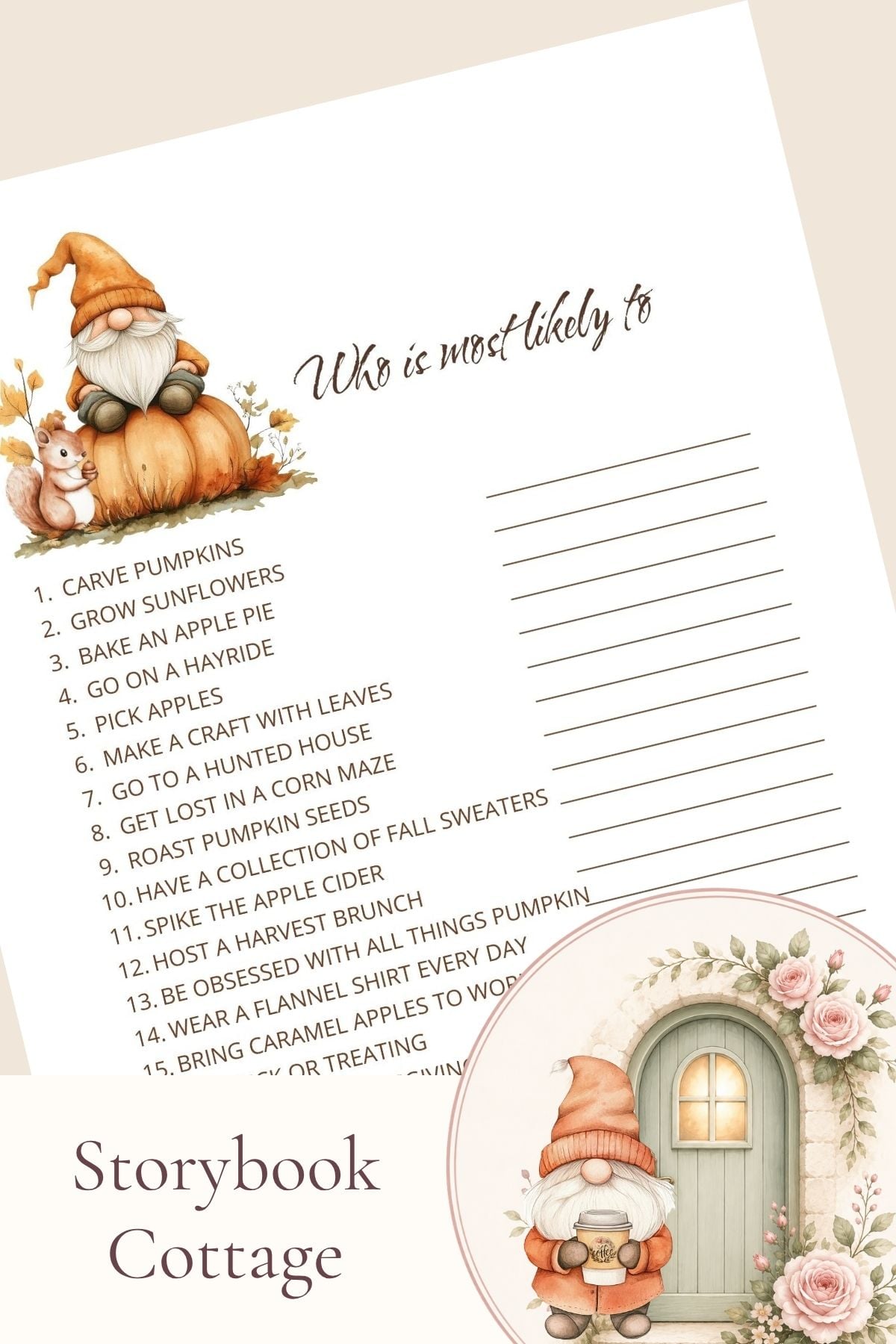
Every group of friends has its personalities. There’s the one who starts wearing fall sweaters the moment September arrives, the pumpkin enthusiast, and perhaps someone who can’t be trusted to navigate a corn maze.
Who’s Most Likely To is a Friendsgiving game that puts those personalities in the spotlight.
What You Need
- A list of Who’s Most Likely To questions
- The printable game sheet, if using one
How to Play
- Read a Who’s Most Likely To question aloud.
- Everyone points to the person they think best fits the description. Have everyone point at the same time.
- See who receives the most votes.
- Let the chosen person defend themselves or admit that everyone knows them a little too well.
- Continue with the next question.
Here are a few autumn-themed examples:
- Who’s most likely to have a collection of fall sweaters?
- Who’s most likely to be obsessed with all things pumpkin?
- Who’s most likely to get lost in a corn maze?
- Who’s most likely to spike the apple cider?
There’s no need to keep score. The entertainment comes from the votes, the explanations, and the occasional disagreement about who really deserves the title.
I’d especially enjoy this one with a group of longtime friends. You might discover that everyone has a very different opinion of who the pumpkin-obsessed friend actually is.
Printable option: Who’s Most Likely To is included in my Gnome Thanksgiving Games collection, along with 14 other games for Thanksgiving, Friendsgiving, and autumn gatherings.
5. Who Said That?
Good fit for: Guessing games · New and longtime friends · Surprising discoveries
Here’s another game about how well you know your friends, but this time the answers are anonymous. Everyone writes down something about themselves, and the group tries to identify who wrote it.
What You Need
- Small cards or pieces of paper
- Pens
- A bowl or basket
How to Play
- Give each guest a card and ask them to write down one surprising or amusing fact about themselves.
- Fold the cards and place them in a bowl.
- The host draws a card and reads it aloud.
- Everyone writes down who they think wrote it.
- Reveal the guesses, then let the writer identify themselves.
- Award one point for each correct guess and continue until all cards have been read. Of course, it gets a bit easier as the game goes along,
The statements can be about childhood adventures, unusual talents, funny experiences, or things people have always wanted to try.
For friends who know each other well, encourage answers that aren’t common knowledge. It’s remarkable how someone you’ve known for years can still have a story you’ve never heard.
6. I Thought of It Too!
Good fit for: Team games · Larger groups · Mind readers · Printable games
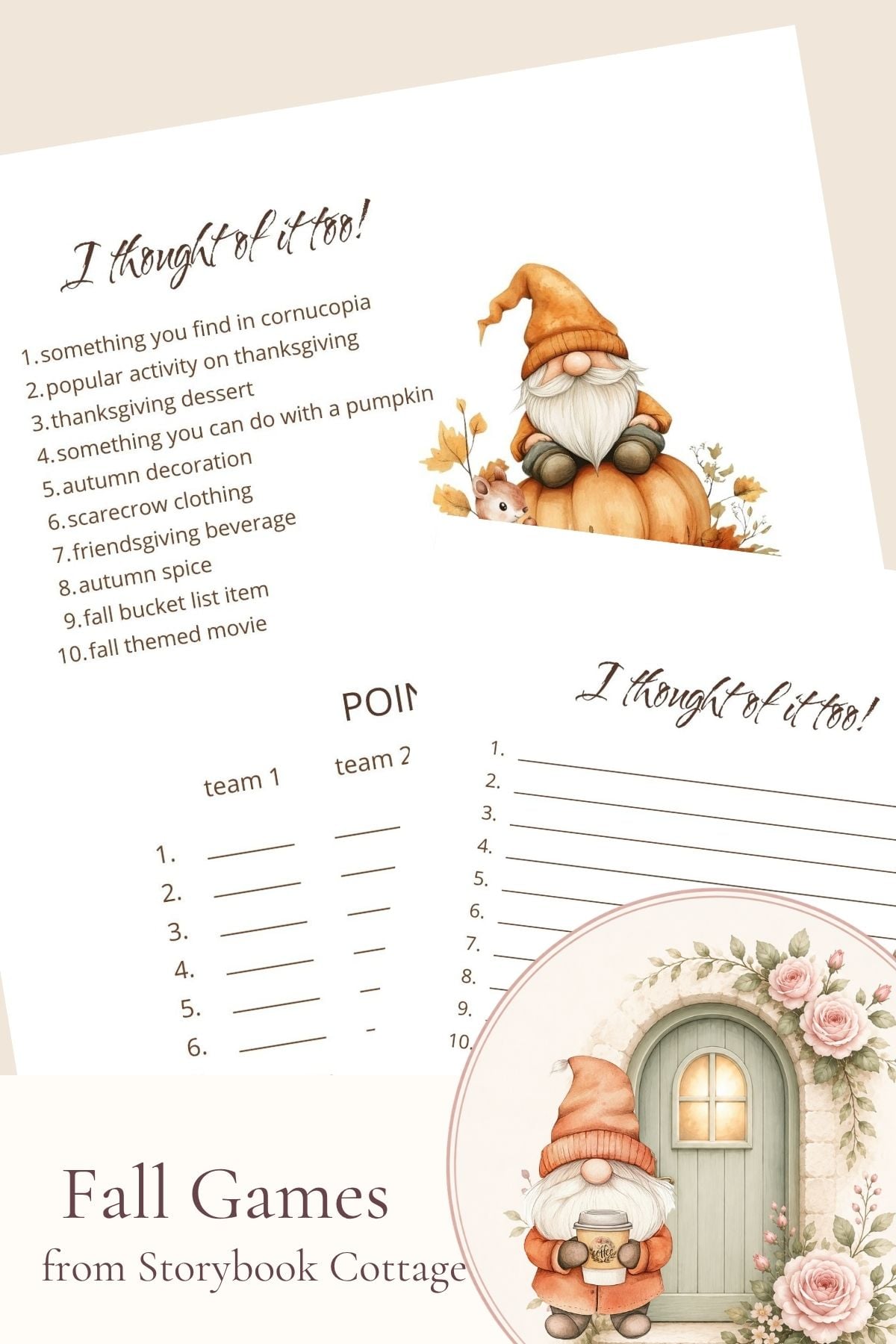
You know that moment when someone says exactly what you were thinking? In I Thought of It Too!, that’s precisely what you want your teammates to do.
Players answer the same autumn-themed questions independently, hoping their responses match those of their teammates.
What You Need
- A game sheet with autumn or Thanksgiving questions
- A pencil for each player
- Paper for keeping score
How to Play
- Divide guests into teams, preferably with at least three people per team.
- Give everyone a question sheet and pencil.
- Read one question aloud.
- Each player writes down the first three answers that come to mind.
- Compare answers within each team.
- Award points for matching responses, then continue to the next question.
Scoring
For teams with five or more players, you can use this scoring system:
- Three teammates write the same answer: the team gets 3 points.
- Four teammates write the same answer: 4 points.
- Five teammates write the same answer: 5 points.
For smaller teams, you can award one point whenever two teammates write the same answer. The team with the most points after all the questions wins.
You could also make the game harder by allowing only one answer per question.
It’s interesting to learn which responses seem completely obvious to you but apparently never occurred to anyone else on your team.
Printable option: My Gnome Thanksgiving Games collection includes I Thought of It Too! and Who Is Most Likely to, along with 13 other autumn games. The 15-game collection has matching gnome illustrations and includes conversation, word, music, and guessing games for Thanksgiving and Friendsgiving gatherings.
You can print a few games for the dinner table or have a selection ready for later in the evening.
7. Friendsgiving Story Relay
Good fit for: Storytelling · Imaginative groups · Unexpected plot twists
What happens when everyone contributes to the same story, but nobody knows where it’s going?
What You Need
- A sheet of paper with a story title and opening sentence already written on it
- Pens or pencils
How to Play
- Before starting, decide how many rounds you’ll play and who will write the final sentence. Or set a timer and when it goes off whoever is holding the paper finishes the story.
- The first player reads the title and opening sentence, then writes one sentence to continue the story.
- The player folds the paper so that the title and opening sentence are hidden, leaving only their own sentence visible.
- Pass the paper to the next player, who reads the visible sentence and adds another sentence to the story.
- That player folds the paper again, hiding everything except the sentence they just wrote.
- Continue passing and folding the paper. Each player sees only what the person immediately before them wrote.
- When it’s time to finish the story, the designated player writes the ending based on the last visible sentence.
Finally, unfold the paper and read the entire story aloud.
Since nobody knows what happened earlier in the story, the plot can take some rather unexpected turns. And discovering how it all began makes the ending even more entertaining.
This written version of a story relay is something I enjoy too. It removes some of the pressure of having to say something clever while everyone is watching. Great for those of us whose imagination temporarily disappears the moment it’s our turn to speak.
8. Chameleon
Good fit for: 3–8 players · Bluffing · Deduction · Short game rounds
Can you tell when one of your friends is bluffing?
The Chameleon is a social deduction board game in which everyone except one player knows the secret word. The Chameleon must pretend to know what everyone else is talking about while trying to figure out the word.
How to Play
- Players receive secret cards. One person receives the Chameleon card.
- A topic card and code reveal a secret word to everyone except the Chameleon.
- Each player gives a one-word clue related to the secret word.
- After hearing the clues, everyone discusses who might be bluffing.
- Players vote on the suspected Chameleon.
If the Chameleon is caught, they still have a chance to escape by correctly guessing the secret word.
The trick is to give a clue specific enough to convince the other players you know the answer, but not so obvious that you reveal it to the Chameleon.
Rounds take around 15 minutes, so you can play a few without committing the entire evening to one board game.
This one suits friends who enjoy bluffing, reading one another, and defending suspiciously vague answers.
Read more about Chameleon.
9. Trivial Pursuit: Friends The TV Series
Good fit for: Trivia games · Friends fans · TV nostalgia
Could you identify a Friends episode from a single clue? Do you remember the characters’ jobs (Chandler??? Transponster?), relationships, and hilarious adventures?
Then Trivial Pursuit: Friends, The TV Series might be worth bringing to Friendsgiving. This is a particularly good choice for friends who watched the show together or still quote their favorite episodes.
How to Play
Use the questions and rules provided with your edition of the game.
For a more social version, divide the guests into teams. Read questions aloud, allow teams to discuss their answers, and keep score.
Of course, this game depends entirely on your guests knowing the show.
10. Candy Corn Transfer
Good fit for: Minute-to-win-it games · Individual challenges · Fast fingers
How many pieces of candy corn can you move with chopsticks in one minute? It sounds straightforward until you’re trying to work against the clock.
What You Need
- Two bowls for each player
- A pair of chopsticks for each player
- Candy corn or another small autumn candy
- A one-minute timer
How to Play
- Place an equal amount of candy in one bowl for each player. Leave the second bowl empty.
- Give each person a pair of chopsticks.
- Start the one-minute timer.
- Players use only their chopsticks to move the candy from one bowl to the other.
- When time runs out, count how many pieces each person successfully transferred.
The player with the most candy in the second bowl wins.
For a larger group, let players compete in heats and bring the winners together for a final round.
Another Candy Game for Friendsgiving
And for a different kind of candy competition, try my Candy Game for Fall Parties. Be prepared for some very determined candy collectors.

This printable game includes 32 autumn-themed cards illustrated with cheerful gnomes.
Players begin with a few pieces of candy, then take turns drawing cards that tell them to give away or collect more. The person with the most candy at the end wins.
And this certainly isn’t just a children’s game! Adults can become surprisingly invested in protecting their candy piles.
See the Fall Candy Game.
11. Pumpkin Bowling
Good fit for: Outdoor games · Active groups · Unpredictable pumpkins
A pumpkin may look vaguely like a bowling ball, but it certainly doesn’t behave like one. That’s part of the entertainment in Pumpkin Bowling.
What You Need
- Small pumpkins
- Ten bowling pins or empty two-liter bottles
- Sand or water to weight the bottles if needed
- Space for a bowling lane
How to Play
- Arrange the pins or bottles at one end of your playing area.
- Mark a starting line.
- Give each player two chances to roll a pumpkin toward the pins.
- Count how many pins each player knocks over.
- Play several rounds and add up the scores.
You can also turn this into a timed challenge and see who can knock down the most pins in one minute.
Pumpkins don’t roll nearly as predictably as bowling balls, especially if the stems or shapes are uneven. I’d put this one outdoors, where wandering pumpkins have some room to roam. And the inevitable mess is more welcome.
12. Cornhole
Good fit for: Outdoor games · Teams or pairs · Casual competition
Cornhole is a good choice when you want an activity people can join without gathering everyone together for a formal game. Set up the boards in the yard and let friends play a few rounds while others talk, watch, or wait for their turn.
What You Need
- Cornhole boards
- Beanbags
How to Play
- Set up the boards facing each other.
- Divide players into two teams or play one against one.
- Players take turns tossing bags toward the opposite board.
- Award points for bags that land on the board or go through the hole, following your set’s scoring rules.
- Continue until a player or team reaches the agreed-upon score.
Cornhole can be a casual background activity or a full tournament, depending on your friends. For an especially competitive group, keep track of the winners and have a final match before dinner.
This premium cornhole game is an excellent addition to your yard game collection. It’s light weight and folding legs make it portable, so you can bring it along to other gatherings as well.
13. Mystery on the Mayflower
Good fit for: Murder mysteries · Large groups (12–30) · Full-evening entertainment
If your friends enjoy mysteries, secret motives, and playing characters, why not make the mystery the main event. Murder! On the Mayflower is a historical murder mystery set aboard the Mayflower in December 1620.
One passenger has died, but was it an accident or murder? Players take on characters, uncover information, question one another, and try to determine what really happened.
What You Need
- The purchased Murder! On the Mayflower game
- Printed character materials and host instructions
- Approximately 1½–2½ hours for gameplay
The game is designed for 12–30 players, and the host can participate without knowing who the murderer is, making it even more fun for her.
The Mayflower setting also gives you plenty to play with: a candlelit dinner, a few period-inspired details, and perhaps a little dramatic flair. Imagine a table full of friends, each with a character to play, secrets to uncover, and growing suspicions about who might be hiding the truth.
Choosing the Right Games for Your Friendsgiving
Some Friendsgiving gatherings call for a little friendly competition, while others are all about conversation and stories. I like to begin by thinking about the people who are coming and what kind of evening I’d like this to be.
- For a group that doesn’t know one another well, Never Have I Ever or Sweet Talk gives guests something to talk about.
- If everyone has been friends for years, Who, What, Where or What Would _____ Choose? can reveal how much they remember about one another.
- For friends who enjoy competition, try I Thought of It Too!, The Chameleon, or one of the active challenges.
- And if you want an entire evening built around a game, choose the murder mystery and let the story unfold.
I also like the idea of making a few games part of the table setting. Printable autumn-themed game sheets could wait beside the plates with pencils, while a little bowl of conversation prompts invites guests to pick a question when they feel like it.
If your Friendsgiving is more about lingering around the table than getting everyone up for a game, I also made three printable Friendsgiving games on one page: Who’s Most Likely To, Finish My Phrase, and This or That. Give everyone a copy, compare answers, and see what stories come out.
Sometimes one game leads to another and sometimes a single question turns into twenty minutes of stories.
Either way, the point is to enjoy being together.
A Storybook Note
Thank you for spending time in Storybook Celebrations today. If you enjoy turning ordinary gatherings into stories worth remembering, I’d love to welcome you to Storybook Cottage as we create a beautiful home one small story at a time.
With warmth and a storybook sprinkle,
Tuula
The Storybook Cottage Grandma
More from Storybook Celebrations
These Friendsgiving games are part of Storybook Celebrations, where simple party games, seasonal gatherings, and imaginative Story Worlds all have a place.
- Thanksgiving Games for Adults – More games for holiday dinners, family gatherings, and friendly competition.
- Cozy Autumn Soup Night for Four – A welcoming autumn dinner idea for a smaller gathering of friend
- Fall Dinner Party Themes – Ideas for creating different autumn party settings and atmospheres.
Wander Through Other Corners of the Storybook Cottage
- Guest Stays: Fall Welcome Basket for Overnight Guests – Thoughtful ways to welcome friends who are staying the night.
- The Cottage: Faded Garden: Romantic Fall Living Room Decor – Come see how faded flowers, autumn leaves, and a few unexpected details brought a different kind of autumn into the Rose Parlour.